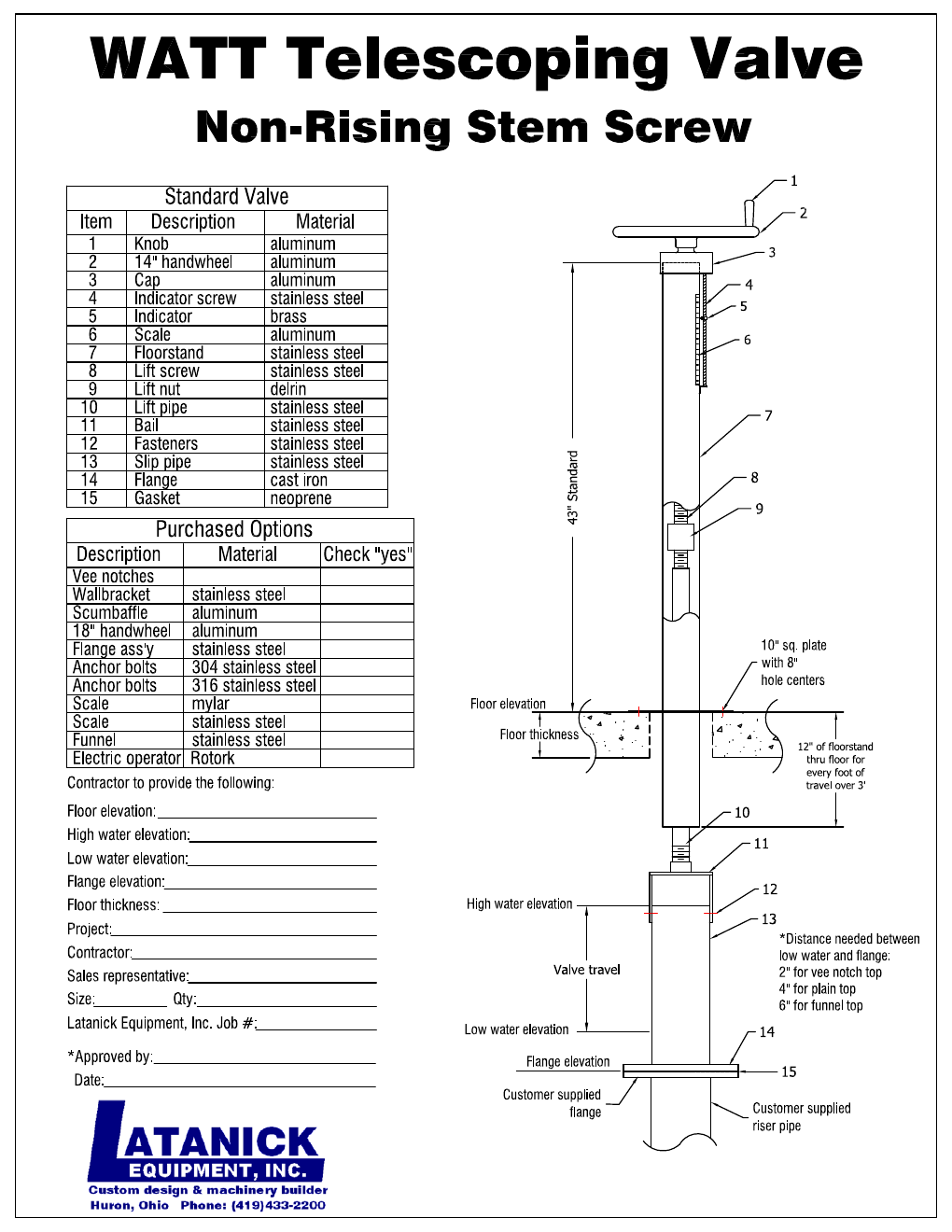
NRS Telescoping Valve
In the Non-Rising Stem design, the operating stem remains stationary while the stem nut travels along it to lift or lower the gate. Because the stem does not extend above the operator, the NRS valve has a compact above-grade footprint, ideal where overhead clearance is limited or where the valve must be installed in a vault, manhole, or tight structure.
- ✓ Compact overhead profile, stem stays flush with operator
- ✓ Suitable for vault, pit, and below-grade installations
- ✓ Stainless steel frame and seating standard
- ✓ Available with wall thimble, flange, or embedded mounting
- ✓ Wide range of sizes and head pressure ratings
Product Submittals
PDF submittals include dimensional drawings, materials, pressure ratings, and ordering information.
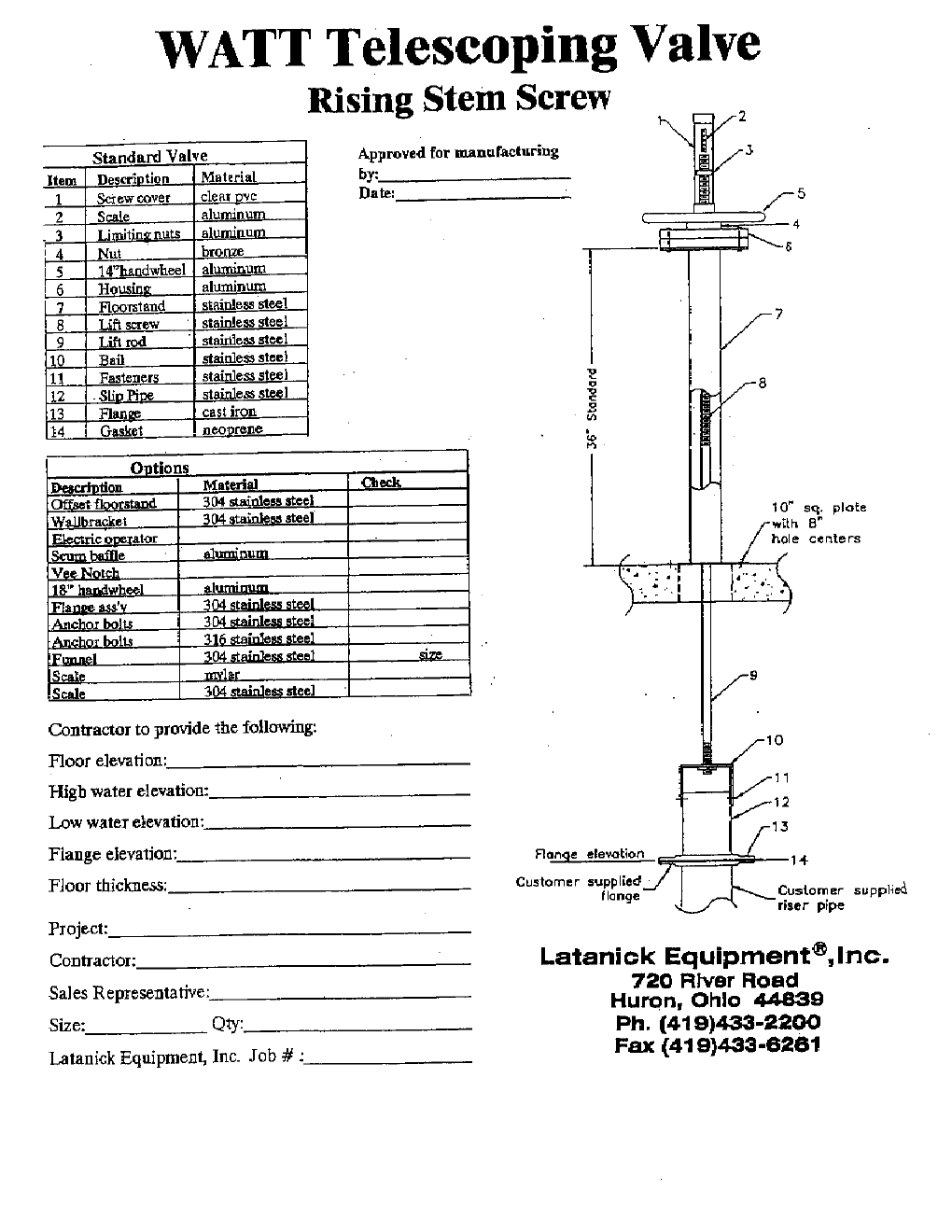
RSS Telescoping Valve
The Rising Stem Screw design is the traditional above-grade slide gate. The threaded stem rises visibly as the valve opens, providing instant visual confirmation of gate position without any secondary indicator. The RSS is favored in accessible, above-grade canal and pipeline installations where the position of the gate needs to be verified at a glance.
For larger gate sizes or high-velocity applications where lateral forces on the gate are significant, the RSS with Guide Rods variant adds parallel guide rods alongside the stem to provide additional lateral support and prevent gate deflection during operation.
- ✓ Visible stem position indicates open/closed at a glance
- ✓ Simple, field-serviceable design with minimal moving parts
- ✓ Guide rod variant available for larger sizes and high-flow conditions
- ✓ Compatible with floor stands, wall brackets, and extension stems
- ✓ Suitable for canal headgates, reservoir outlets, and lift stations
Product Submittals
PDF submittals include dimensional drawings, materials, pressure ratings, and ordering information.
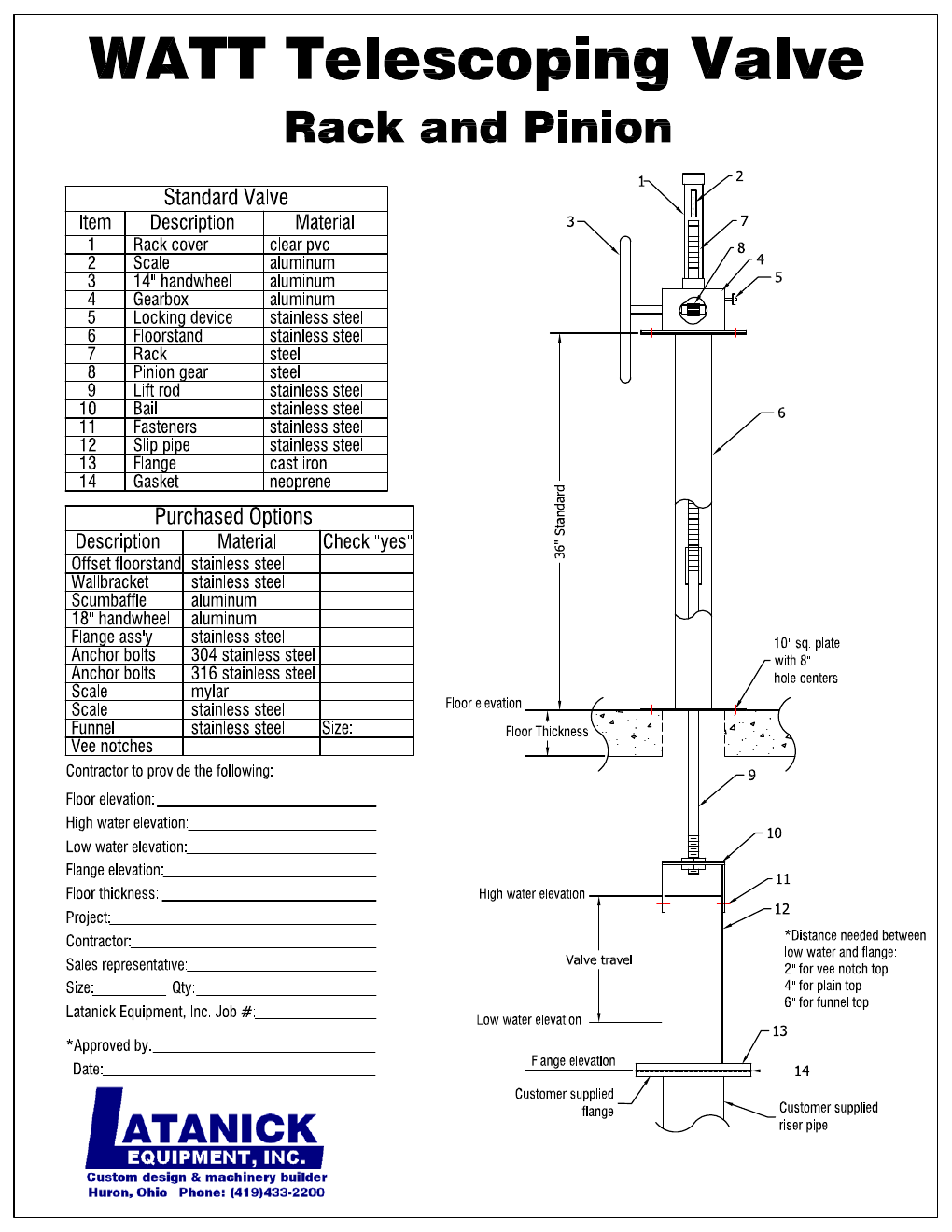
R&P Telescoping Valve
The Rack & Pinion design replaces the screw stem with a toothed rack and pinion gear system. The pinion gear drives the rack, attached directly to the gate, up or down with each rotation. This mechanism produces greater mechanical advantage than a screw stem of the same size, making it better suited to larger gates, higher operating loads, and applications requiring frequent cycling.
Because the R&P drive is self-contained and accepts standard actuator mounting flanges, it is the preferred choice for electric motor, hydraulic, or pneumatic automation. Remote operation, SCADA integration, and automated flow management systems are all straightforward with the Rack & Pinion valve.
- ✓ Higher mechanical advantage for large gates and heavy-duty operation
- ✓ Designed for motor, hydraulic, and pneumatic actuator mounting
- ✓ Ideal for remote operation and SCADA/automated systems
- ✓ Compact operator housing relative to gate size
- ✓ Handles frequent cycling without excessive stem wear
Product Submittals
PDF submittals include dimensional drawings, materials, pressure ratings, and ordering information.